If you've noticed your driveway isn't as level as it used to be, you're not alone. Driveway sinking and settlement is one of the most common concrete problems Alabama homeowners face, especially in areas with clay-heavy soil. The good news? Catching it early can save you thousands of dollars and prevent more serious foundation issues down the road.
In this comprehensive guide, we'll walk you through everything you need to know about sunken driveways—from identifying the warning signs to understanding your repair options and costs.
Table of Contents
- Warning Signs Your Driveway Is Sinking
- 5 Common Causes of Driveway Settlement in Alabama
- Why Alabama Driveways Are Especially Vulnerable
- Repair Options: Cost Comparison
- How Long Does Driveway Repair Take?
- DIY Inspection Checklist
- When to Call a Professional
Warning Signs Your Driveway Is Sinking
Before we dive into causes and solutions, let's identify whether your driveway is actually sinking. Here are the telltale signs:
1. Visible Gaps Between Driveway and Garage
One of the most obvious indicators is a growing gap where your driveway meets your garage floor. This gap often starts small—maybe a quarter-inch—but can grow to several inches over time.
Why it matters: This gap allows water to flow toward your foundation, potentially causing basement flooding or foundation settlement.
2. Water Pooling After Rain
Does water collect in certain areas of your driveway after it rains? This is a clear sign that sections have settled below their original grade.
Why it matters: Standing water accelerates concrete deterioration, causes freeze-thaw damage in North Alabama, and creates slippery, unsafe conditions.
3. Cracks in Your Driveway
While not all cracks indicate sinking, certain patterns are red flags:
- Stair-step cracks along the edges
- Settlement cracks that run perpendicular to the street
- Widening cracks that grow over time
Why it matters: Cracks allow water to penetrate beneath the slab, washing away soil and accelerating settlement.
4. Sloping Toward Your Home
Use a level or simply roll a ball across your driveway. If it consistently rolls toward your house rather than toward the street, you have a grading problem.
Why it matters: Water should drain AWAY from your home. A backward slope directs water toward your foundation—the last place you want it.
5. Uneven Surface When Driving
Do you feel a noticeable "bump" or drop when pulling into your garage? Can you see visible height differences between concrete sections?
Why it matters: Beyond being annoying, uneven surfaces damage vehicles over time and create liability risks if someone trips.
6. Separation from Sidewalks or Steps
Gaps appearing between your driveway and adjacent structures (like front steps or sidewalks) indicate differential settlement—different sections sinking at different rates.
5 Common Causes of Driveway Settlement in Alabama
Understanding WHY your driveway is sinking helps you choose the right repair method and prevent future problems. Here are the five most common culprits we see in Alabama:
Cause #1: Soil Erosion from Water Damage
What happens: Alabama receives an average of 50-60 inches of rain annually—well above the national average. When water penetrates beneath your driveway through cracks or poor drainage, it slowly washes away the supporting soil.
Why it's worse in Alabama: Our heavy spring storms and occasional tropical weather systems can dump several inches of rain in hours, creating rapid erosion conditions.
The fix: Address both the settlement (lift the concrete) AND the water issue (improve drainage, seal cracks).
Cause #2: Poor Soil Compaction During Construction
What happens: When builders don't properly compact the soil base before pouring concrete, it settles over time under the driveway's weight—especially in Alabama's soft clay soils.
Warning signs: Settlement often appears within the first 2-5 years after construction if this is the cause.
The fix: Polyurethane foam injection fills voids, compacts loose soil, and provides permanent support.
Cause #3: Expansive Clay Soil Movement
What happens: Alabama is notorious for expansive clay soils that shrink during dry periods and swell when wet. This constant movement creates voids beneath concrete slabs.
Why it's worse in Alabama: Counties like Jefferson, Shelby, Mobile, and Montgomery have particularly problematic clay content.
Seasonal pattern: You'll often notice worsening during dry summer months when clay contracts most.
The fix: Stabilize the soil with high-density foam that resists future movement.
Cause #4: Tree Root Growth
What happens: Large trees near your driveway (within 20-30 feet) can cause problems in two ways:
- Root growth lifts or cracks concrete
- Water absorption dries out soil beneath slabs, causing settlement
Common culprits in Alabama: Oak trees, pine trees, and pecan trees with aggressive root systems.
The fix: Root barriers, strategic tree removal, and concrete lifting to restore level.
Cause #5: Plumbing Leaks or Drainage Issues
What happens: Underground water or sewer line leaks saturate soil beneath your driveway, causing it to wash away or lose stability.
Red flags:
- Wet spots that won't dry
- Unexplained water bills
- Lush grass growing along driveway edges
The fix: Repair the plumbing issue FIRST, then lift the concrete.
Why Alabama Driveways Are Especially Vulnerable
If you're wondering why driveway problems seem so common in Alabama, here's the reality: our state faces a perfect storm of conditions that accelerate concrete settlement.
Alabama's Soil Composition
- High clay content: Most of Alabama sits on expansive clay soils that move with moisture changes
- Poor drainage characteristics: Clay doesn't allow water to percolate quickly
- Soft subsoils: Many areas have weak supporting soils that compress under weight
Climate Factors
- High rainfall: 50-60 inches annually (vs. 38-inch national average)
- Humidity: Keeps soil moist, contributing to erosion
- Temperature swings: North Alabama experiences freeze-thaw cycles
- Storm severity: Heavy downpours cause rapid erosion
Regional Differences Within Alabama
North Alabama (Huntsville, Decatur, Florence):
- Limestone bedrock creates sinkholes and voids
- Freeze-thaw cycles in winter
- Red clay soils
Central Alabama (Birmingham, Tuscaloosa, Montgomery):
- Heavy clay content
- Rolling terrain = drainage challenges
- Historic mining areas with unstable subsoils
South Alabama (Mobile, Dothan, Baldwin County):
- High water table
- Sandy soils mixed with clay
- Hurricane and tropical storm impacts
- Coastal erosion factors
Repair Options: Why Polyurethane Foam Is the Clear Winner
When your driveway is sinking, you have three repair options. But here's what most Alabama homeowners discover: only one method actually makes sense for our soil and climate conditions.
The Smart Choice: Polyurethane Foam Injection
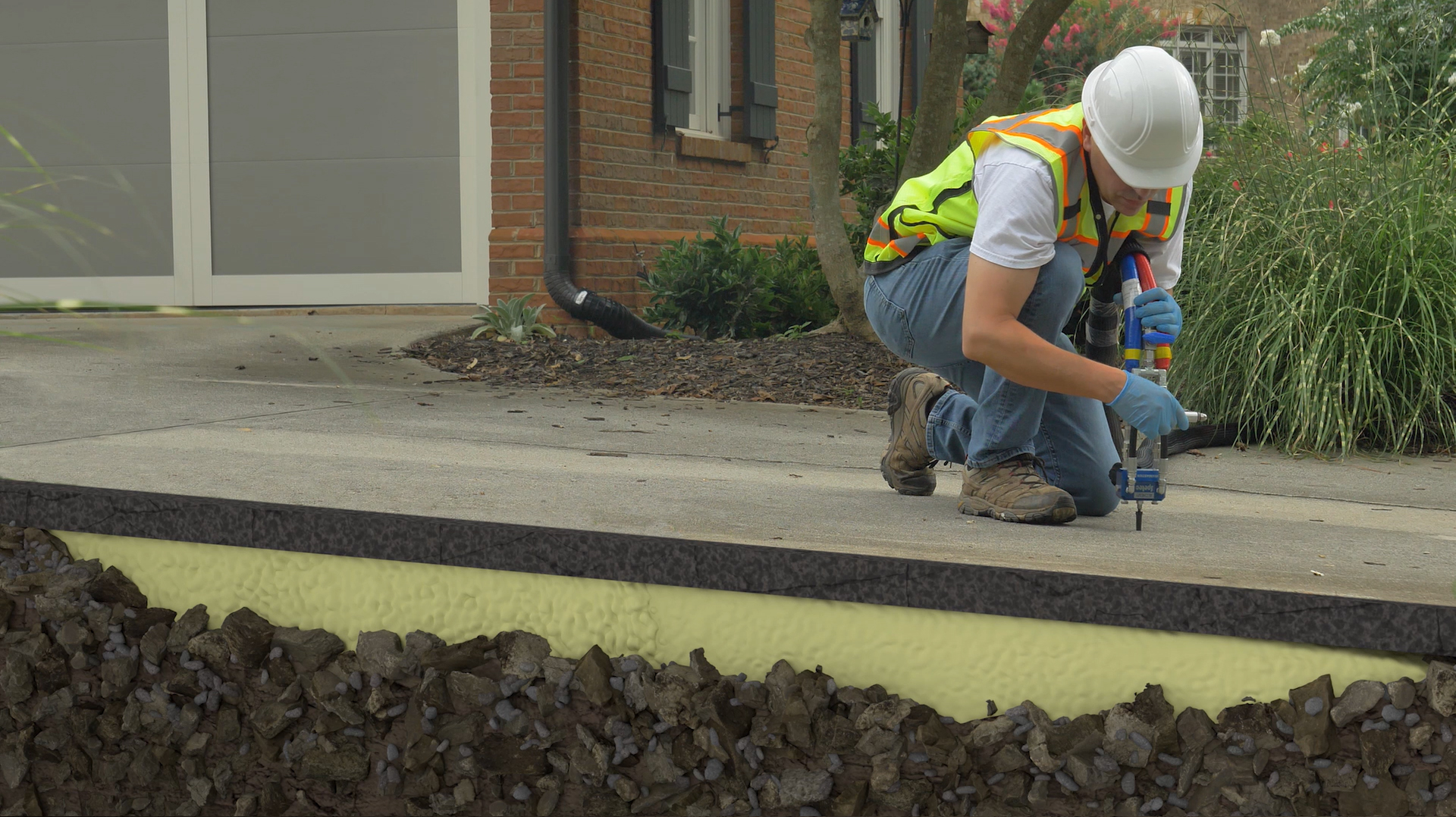
How it works: Small, penny-sized holes are drilled through the concrete, and expanding polyurethane foam is injected beneath the slab. The foam expands within seconds, filling every void and lifting the concrete back to level with surgical precision.
Timeline: 2-4 hours for most driveways—drive on it immediately
Cost: $5-$15 per square foot (typically $800-$2,500 for residential driveways)
Why It's the Only Real Solution for Alabama:
- ✅ Permanent fix—closed-cell foam won't wash out, shrink, or deteriorate
- ✅ Waterproof—actually repels the water that caused your problem
- ✅ Lightweight—weighs just 2-4 lbs per cubic foot vs. 100+ lbs for mud slurry
- ✅ Zero cure time—drive on it the same day
- ✅ Tiny holes—nearly invisible after repair (5/8" vs 2" for mudjacking)
- ✅ Stabilizes soil—foam compacts loose soil while lifting
- ✅ 10+ year lifespan—often lasts the life of the concrete
- ✅ Works in Alabama's clay—specifically designed for unstable soil conditions
Why We Don't Recommend Mudjacking in Alabama
Mudjacking (also called slabjacking) uses a heavy cement-based slurry pumped beneath your concrete. While it costs less upfront, it's a poor choice for Alabama properties—here's why:
The Hidden Problems:
- ❌ Adds 100+ lbs per cubic foot to already failing soil—often accelerates future settling
- ❌ Washes out in 3-7 years—Alabama's 55+ inches of annual rain erodes the slurry
- ❌ Shrinks and cracks—cement-based materials deteriorate over time
- ❌ 2" holes required—visible and unsightly
- ❌ 24-48 hour cure time—can't use your driveway
- ❌ Doesn't seal against water—the root cause continues
The Math That Matters: If you pay $1,200 for mudjacking and it fails in 5 years, you'll pay again. Two mudjacking jobs = $2,400+. One polyurethane job at $1,800 lasts 10+ years. Foam costs less over time.
Option 3: Complete Replacement
How it works: Tear out existing concrete, re-grade and compact soil, pour new concrete.
Timeline: 5-7 days; 7-14 days cure time before driving
Cost: $8-$15 per square foot (typically $2,400-$6,000+ for residential driveways)
Pros:
- ✅ Brand new surface
- ✅ Opportunity to improve design or drainage
Cons:
- ❌ Most expensive option (3-5x cost of lifting)
- ❌ Major disruption (can't use driveway for 1-2 weeks)
- ❌ Doesn't address underlying soil issues
- ❌ Environmental waste (tons of concrete to landfill)
- ❌ New concrete could still settle if soil isn't properly stabilized
Best for: Driveways with severe structural damage, extensive cracking, or when you want to change the design.
Real Cost Example: Birmingham Homeowner
Scenario: 500 sq ft driveway settled 2 inches, creating garage gap
| Method | Upfront Cost | 10-Year Cost | Downtime | Result |
|---|---|---|---|---|
| Polyurethane Foam | $1,800 | $1,800 | 3 hours | ✅ Permanent fix |
| Mudjacking | $1,200 | $2,400+ (needs redoing) | 2-3 days | ❌ Temporary |
| Replacement | $5,500 | $5,500+ | 2 weeks | ⚠️ May still settle |
Bottom line: Polyurethane foam injection costs less over time, works immediately, and actually solves the problem instead of temporarily masking it.
How Long Does Driveway Repair Take?
Time is money, especially when you can't use your driveway. Here's why polyurethane foam injection is the clear winner:
Polyurethane Foam Injection: The Fast Solution
- Appointment scheduling: Often same-week availability
- Actual repair: 2-4 hours for most driveways
- Cure time: Zero—drive on it immediately
- Total downtime: Just 2-4 hours
Compare that to replacement (10-17 days without your driveway) or mudjacking (2-3 days waiting for cure). With polyurethane foam, we arrive in the morning and you're using your driveway by lunch.
DIY Inspection Checklist
Before calling a contractor, do this quick 15-minute inspection:
Tools needed:
- 4-foot level
- Tape measure
- Garden hose
- Smartphone camera
Step-by-Step:
- ☐ Measure gaps between driveway and garage (record measurements)
- ☐ Check for standing water after rain (note locations)
- ☐ Document all cracks (take photos, measure widths)
- ☐ Test drainage by running hose—where does water flow?
- ☐ Use level to measure slope toward house vs. street
- ☐ Inspect edges for signs of soil erosion beneath slabs
- ☐ Check adjacent structures (sidewalks, steps) for separation
- ☐ Look for tree roots within 30 feet
- ☐ Note settlement patterns (which sections are lowest?)
- ☐ Take overview photos from multiple angles
Pro tip: Do this inspection after heavy rain for the most accurate picture of water issues.
When to Call a Professional
Some situations require immediate professional attention:
Call Today If You See:
- Gaps larger than 1 inch between driveway and garage
- Water flowing toward foundation during rain
- Rapidly widening cracks (growing month-to-month)
- Multiple sections settling at different rates
- Basement moisture or foundation cracks appearing
Schedule Within a Month If You Notice:
- Minor settlement (under 1 inch)
- Small cracks that aren't growing rapidly
- Slight water pooling that drains within hours
- Cosmetic concerns that bother you
Why Act Sooner Rather Than Later:
Reason 1: Settlement Accelerates
Small problems become big problems. That 1-inch gap can become 4 inches in a single rainy season.
Reason 2: Water Damage Compounds
Every rain event washes away more supporting soil, making the repair more expensive.
Reason 3: Foundation Risk
Water directed toward your home threatens your foundation—a $10,000+ problem vs. a $2,000 driveway fix.
Reason 4: Liability
Sunken driveways create trip hazards. You could be liable if someone is injured on your property.
What to Expect from a Free Inspection
Reputable Alabama concrete lifting companies (like Alabama Polylift) offer free, no-obligation inspections. Here's what should happen:
During the Visit (45-60 minutes):
- Visual assessment of settlement patterns
- Level measurements to quantify the problem
- Soil evaluation to identify the cause
- Drainage assessment to spot water issues
- Photo documentation
- Honest assessment of repair options
You Should Receive:
- Written estimate with clear pricing
- Before/after photos of similar projects
- Explanation of the process
- Timeline estimate
- Warranty information
- References from local customers
Red Flags (Walk Away If):
- Pushy sales tactics or "today only" pricing
- Refusal to provide written estimates
- No insurance or licensing verification
- Vague answers about methodology
- No local references
Preventing Future Driveway Settlement
Once your driveway is repaired, protect your investment:
Maintenance Tips:
- Seal cracks promptly (within weeks of appearing)
- Ensure proper drainage away from driveway edges
- Clean gutters so overflow doesn't saturate soil
- Address plumbing leaks immediately
- Monitor tree growth near driveway
- Seal concrete every 2-3 years
- Fix grading issues that direct water toward slabs
Annual Inspection:
Each spring and fall, spend 10 minutes checking for:
- New cracks
- Changing settlement patterns
- Drainage problems
- Signs of erosion
The Bottom Line: What Alabama Homeowners Should Know
If your driveway is sinking, here's what matters most:
✓ Act early. Small settlement problems are easier and cheaper to fix than major failures.
✓ Address the cause. Lifting the concrete without fixing water or soil issues is a temporary solution.
✓ Choose the right method. In Alabama's challenging soil conditions, polyurethane foam injection offers the best combination of performance, longevity, and value.
✓ Work with experts. Proper diagnosis and repair require experience with Alabama's unique soil and climate challenges.
✓ Get multiple quotes. But remember: the cheapest option isn't always the best value.
Ready to Fix Your Sinking Driveway?
Alabama Polylift has lifted hundreds of driveways across Alabama using advanced polyurethane foam injection technology. Our process is:
- ✅ Fast (most jobs done in 2-4 hours)
- ✅ Permanent (won't wash out or settle again)
- ✅ Affordable (50-70% less than replacement)
- ✅ Guaranteed (backed by our warranty)
Get Your Free Inspection: Schedule online or call us today. We'll assess your specific situation, explain your options, and provide a clear, written estimate—no pressure, no games.
Serving all of Alabama: Birmingham, Huntsville, Montgomery, Mobile, Tuscaloosa, Hoover, Dothan, Auburn, Decatur, Madison, and surrounding counties.
Related Articles:
- How Much Does Concrete Leveling Cost in Alabama?
- Polyurethane Foam Injection vs. Mudjacking: Which Is Better?
- 5 Signs Your Foundation Needs Immediate Attention
Last Updated: November 2025